
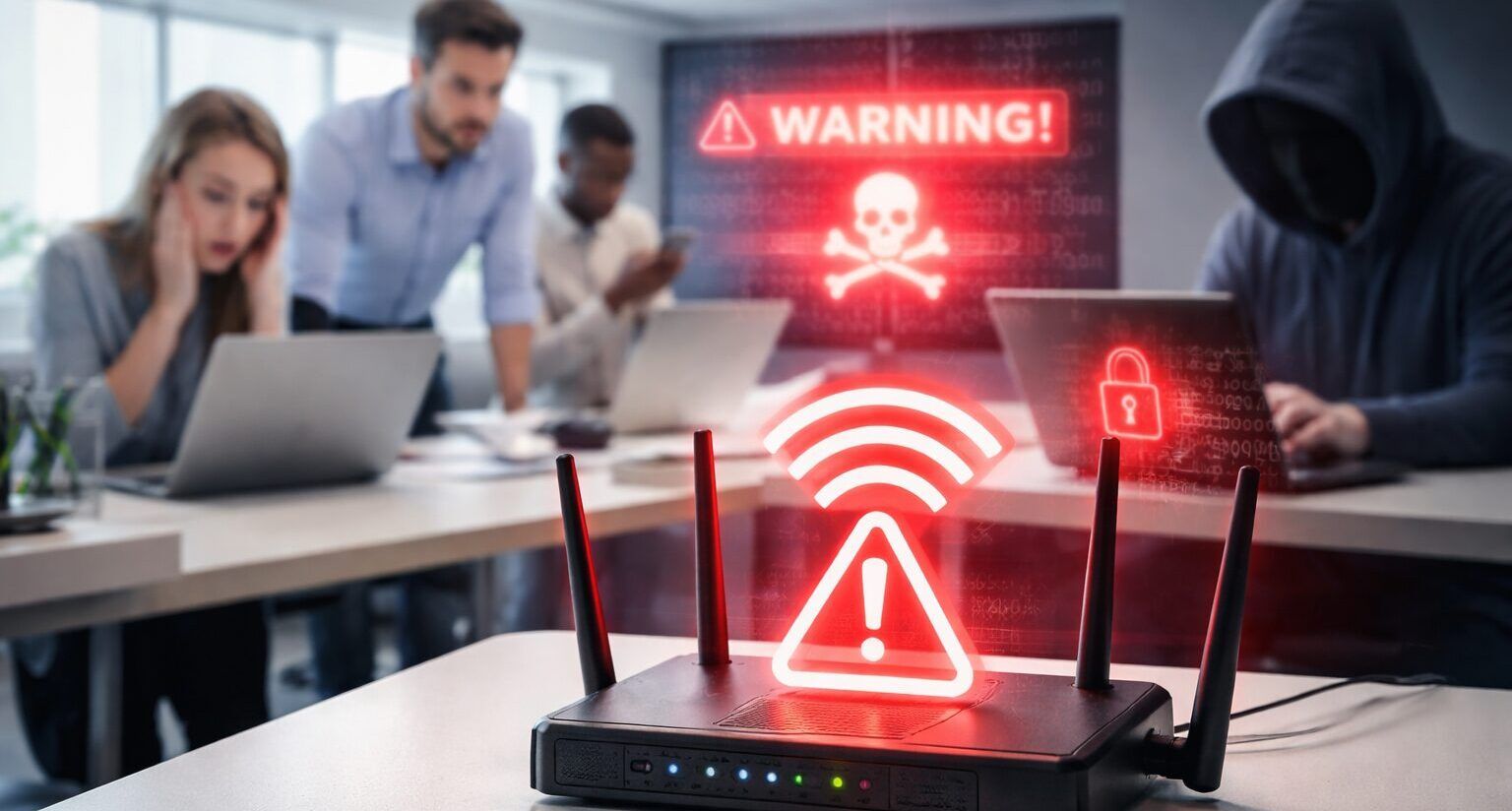
Picture this. Your team gathers in the conference room for an important strategy meeting. Laptops connect seamlessly to the office Wi-Fi. Presentations load. Notes sync to the cloud. Then everything freezes. Screens go dark. Files become inaccessible. A quiet panic spreads as someone realizes this is not a simple outage. A hacker parked nearby just exploited a weakness in your wireless network. Data may already be on its way to the deep/dark web.
This scenario plays out more often than most business leaders realize. Today companies depend on Wi-Fi for everything from daily operations to critical infrastructure. Yet the air around your building has become a battlefield. Attackers no longer need physical access. They strike from the parking lot or even farther with the right equipment. The result can be stolen customer records, ransomware demands, or complete operational shutdowns. Wireless penetration testing, often called Wi-Fi testing, stands out as one of the most effective ways to expose these hidden risks before real damage occurs.
The Growing Wireless Battlefield in Modern Businesses
Businesses have never been more connected. Hybrid work, mobile devices, and smart office equipment have turned Wi-Fi into the backbone of daily operations. Employees bring personal laptops and phones. Conference rooms feature wireless displays. Factories and warehouses use IoT sensors on the same network. This convenience comes at a price.
Recent studies reveal the scale of the problem. One 2025 report found that 32.5 percent of all devices on corporate networks operate completely unmanaged. These include personal BYOD gadgets and thousands of IoT items such as printers, security cameras, and smart thermostats. Worse, nearly half of all connections from IoT devices to company systems come from high-risk equipment that lacks proper security controls.
Attackers know this. Routers and wireless access points now account for over 75 percent of observed IoT related incidents. Cyber-criminals target these entry points to launch ransomware, steal credentials, or move deeper into the network. With billions of connected devices worldwide the attack surface grows daily. Many businesses treat Wi-Fi as a simple utility rather than the critical security perimeter it has become.
Real Attacks That Exposed the Wireless Weakness
High profile incidents in 2025 showed just how devastating Wi-Fi related attacks can be. The China linked Salt Typhoon group infiltrated major telecommunications providers including Verizon, AT&T, and T Mobile. They exploited weaknesses in wireless infrastructure and routers to access call metadata and sensitive records for over a million users. The breach reached into law enforcement and intelligence systems highlighting how a single wireless compromise can ripple across entire sectors.
Smaller businesses faced similar pain. In one case a manufacturing firm lost production for days after attackers used a rogue access point to deploy ransomware. The intruders never touched a wired connection. They simply mimicked the company WiFi and waited for employees to connect. Recovery costs exceeded hundreds of thousands of dollars including lost revenue and regulatory fines.
These stories are not isolated. Verizon’s 2025 Data Breach Investigations Report noted a sharp rise in incidents involving wireless vectors especially when combined with BYOD or IoT devices. The message is clear. What looks like a minor convenience issue can quickly become a major business threat.
Vulnerabilities Lurking in the Airwaves
Many Wi-Fi attacks succeed because of known but overlooked flaws. A standout example from early 2026 is CVE 2025 14631. This high severity vulnerability affects Broadcom Wi-Fi chipsets found in popular routers from TP Link, ASUS, and other vendors. An attacker within radio range can send a single malformed frame over the air with no authentication required. The result is an immediate crash of the 5 GHz network. All connected devices disconnect and the router often needs a manual reboot to recover. The flaw bypasses WPA2 and WPA3 encryption and works on both main and guest networks. Patches exist but many organizations delay updates leaving them exposed.
Other common weaknesses include weak or default passwords on access points, outdated encryption protocols, and misconfigured guest networks that allow lateral movement. Rogue access points installed by employees or attackers create hidden backdoors. Evil twin attacks trick users into connecting to fake networks that look identical to the real one. The problem grows worse with modern setups. Many businesses still run WPA2 alongside WPA3 creating mixed environments that attackers can downgrade. Public or shared networks in office buildings add another layer of risk.
BYOD and IoT Devices: Unseen Vulnerabilities on Your Network
Bring your own device policies and the explosion of IoT equipment have quietly expanded the danger zone. Employees connect personal phones and laptops that may carry malware from home networks or public hotspots. These devices often lack enterprise grade protections and bypass corporate controls.
IoT devices compound the issue. Smart lighting, video doorbells, and industrial sensors frequently ship with factory default credentials and minimal security updates. When they join the same Wi-Fi as business systems they become perfect stepping stones for attackers. A compromised security camera can serve as a launchpad for deeper network infiltration.
Studies confirm the scale. In 2025 over 63 percent of organizations reported at least one IoT related security incident. Many of these started on wireless networks. Without proper segmentation a single vulnerable coffee machine or printer can expose customer databases or financial systems.
These devices rarely appear on standard vulnerability scans. They hide in plain sight on the wireless layer creating blind spots that traditional security tools miss.
Wi-Fi Testing: Shining Light on Hidden Dangers
Wireless penetration testing provides the clearest view into these risks. Unlike automated scans that only check for known signatures ethical hackers simulate real world attacks against your specific environment. They test from outside the building and inside offices to mimic both external intruders and insider threats.
A thorough Wi-Fi test uncovers rogue access points employees may have added for convenience. It reveals weak encryption settings and default passwords on IoT devices. Testers attempt evil twin setups to measure how easily staff connect to fake networks. They evaluate device isolation to see if a hacked printer can reach the server room.
The process also examines BYOD behavior. Testers check whether personal devices can bypass network controls and reach sensitive resources. Results come with clear prioritized recommendations. Organizations learn exactly which devices or configurations create the biggest exposure and how to fix them.
Many compliance frameworks now require regular wireless testing. These include PCI DSS which mandates wireless assessments and penetration testing for organizations handling payment card data, ISO 27001 which demands comprehensive risk assessments of wireless infrastructure, SOC 2 which evaluates wireless security as part of trust services criteria, and HIPAA which requires protection of electronic protected health information transmitted over wireless networks. The insights gained far outweigh the effort. Companies that test proactively avoid the costly breaches that hit unprepared competitors.
Securing the Airwaves Around Your Business
Wireless networks will only grow more central to business success in the coming years. Yet without proper attention they represent one of the easiest paths for attackers to enter. The combination of sophisticated threats like CVE 2025 14631, widespread BYOD usage, and vulnerable IoT devices creates a perfect storm.
Wi-Fi testing offers a practical way forward. It transforms invisible risks into actionable intelligence. Businesses that invest in understanding their wireless posture gain confidence that their networks can withstand determined adversaries.
The air around your office may feel quiet. But threats move silently through it every day. Taking steps now to test and strengthen your wireless defenses protects data, operations, and the future of your company.
Sources
-
Palo Alto Networks 2025 Device Security Threat Report (paloaltonetworks.com)
-
Black Duck Cybersecurity Research Center Broadcom Wi Fi Chipset Vulnerability Advisory (blackduck.com)
-
Verizon 2025 Data Breach Investigations Report (verizon.com)
-
Krebs on Security Reports on TP Link and Router Vulnerabilities (krebsonsecurity.com)
-
CISA Known Exploited Vulnerabilities Catalog (cisa.gov)
-
Bitdefender 2025 IoT Security Landscape Report (bitdefender.com)
-
Nozomi Networks 2025 OT and IoT Security Report (nozominetworks.com)
-
Bastille Networks Top Wireless Enabled Threats in 2025 (bastille.net)
-
Various incident reports from sources including Reuters and Fierce Network on Salt Typhoon campaigns